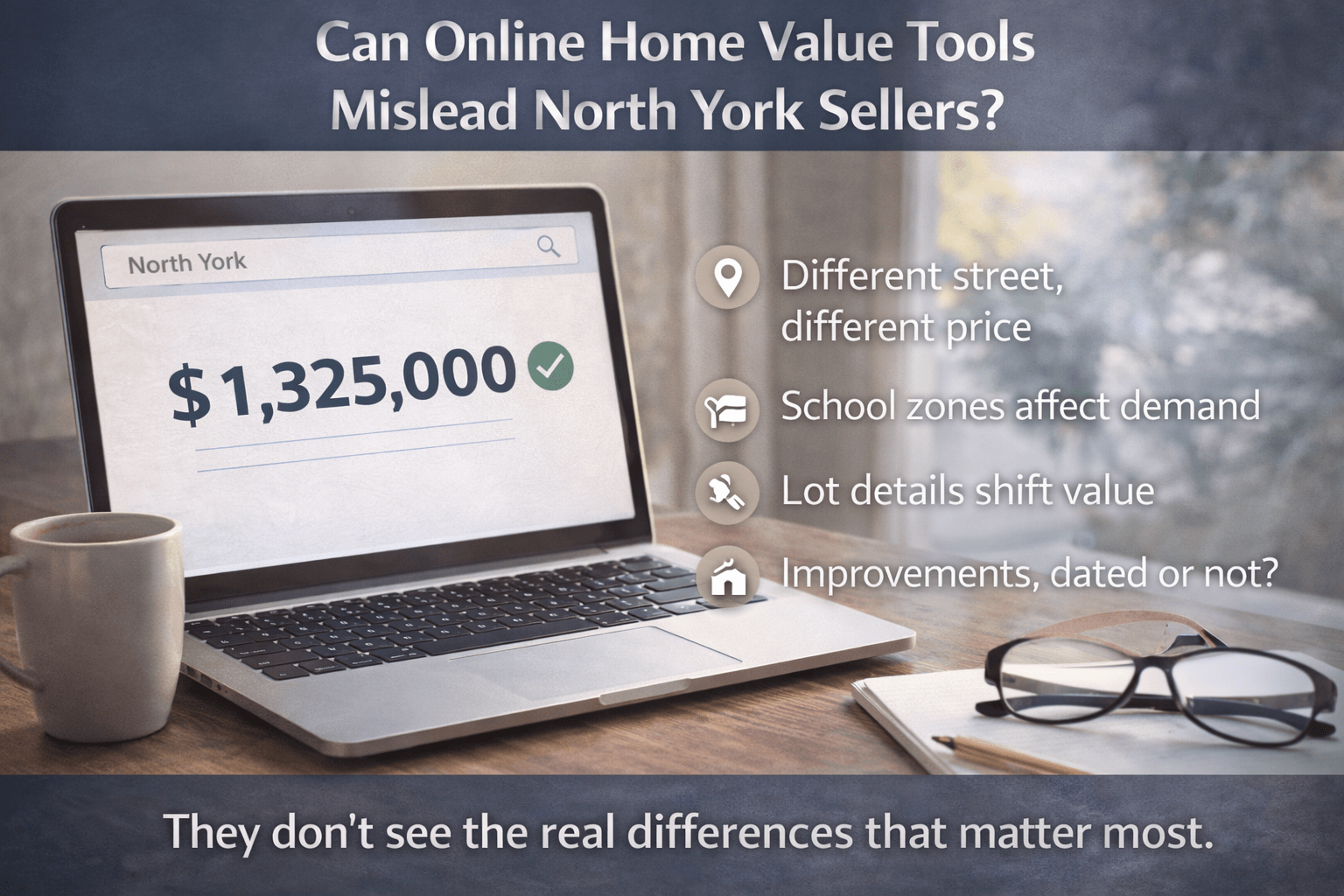
Many homeowners in Bayview Village, Bayview Woods-Steeles, and Don Valley Village start with an online home value tool. It feels quick and reassuring. Type in the address, get a number, and assume it’s close to reality.
The problem is: those numbers are often wrong — sometimes by a lot.
Online tools don’t truly understand freehold homes in North York. They work off broad averages and old sales data. They don’t see the things buyers care about most.
🏠
For example:
Two houses on the same street can have very different values
A quiet crescent and a busier road are priced very differently
School zone perception matters more than many realize
Lot shape, slope, and orientation change demand
Renovations from 15 years ago are treated the same as recent ones
🏠
Automated systems can’t walk through your home.
They don’t know if the basement feels dark or bright.
They can’t tell if the layout feels dated or comfortable.
They don’t feel how buyers react emotionally when they step inside.
🏠
Another issue is timing.
Online tools often lag the market. They may rely on sales from months ago, even though buyer behaviour has already shifted. In North York, market mood changes faster than those systems update.
🏠
This is why many sellers feel confused:
“The website said my home was worth more.”
“Why are showings slow?”
“Why is the feedback not matching the online number?”
It’s not the home.
It’s the data.
Automated values are a starting point at best — not a pricing decision. In areas like Bayview Village, Bayview Woods-Steeles, and Don Valley Village, small differences create big price gaps. Only real, local context explains that properly.
That’s why relying only on online numbers often leads to missed expectations, longer time on market, or unnecessary price changes later.
🏠
Understanding value here requires more than a calculator. It requires knowing how buyers are actually reacting right now, on these streets, to these types of homes.
 Richard Wang